Introduction
If you have ever wondered how powerful Ares was in Greek mythology, you are about to get the full, unfiltered picture — and it is far more complicated than you might expect.
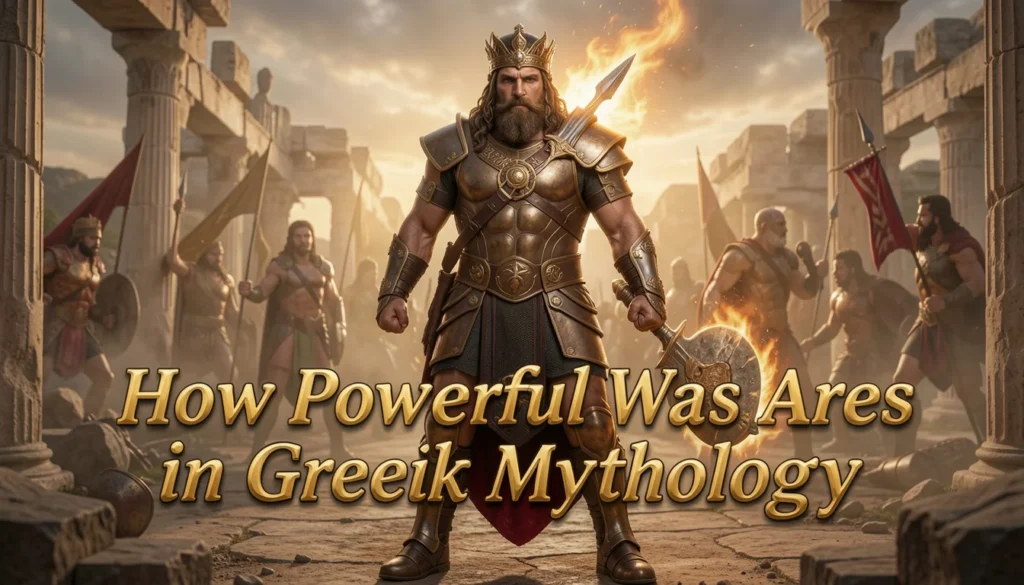
How Powerful Was Ares in Greek Mythology. Ares was the god of war. That title alone sounds terrifying. He stood on battlefields dripping with blood, drove a chariot pulled by fire-breathing horses, and screamed loud enough to shake the earth beneath him. The ancient Greeks described his war cry as the sound of ten thousand soldiers screaming at once.
But here is the twist: Ares was not the all-powerful, unbeatable force you might picture. He lost battles. He got wounded. Other gods humiliated him. Mortals occasionally outmaneuvered him.
So who was he, really? This article breaks down his divine powers, his place in the Greek pantheon, his greatest victories, his most embarrassing defeats, and what made him both feared and disrespected — even by his own family on Mount Olympus.
Who Was Ares in Greek Mythology?
Ares was one of the twelve Olympian gods. He was the son of Zeus, the king of the gods, and Hera, the queen of heaven. In the divine hierarchy, that bloodline put him near the very top of the Greek pantheon.
He represented war in its rawest, most brutal form. Not strategic war. Not the kind of war you plan carefully and win through intelligence. Ares embodied blood lust, chaos, and the savage joy of combat for its own sake.
Ancient Greeks made a clear distinction between Ares and Athena. Athena was the goddess of wisdom and strategic warfare. Ares was the god of the physical violence of war — the screaming, the slaughter, the pure primal ferocity that soldiers feel when battle takes over their senses.
He had four divine children with Aphrodite, the goddess of love. Their relationship produced Phobos (Fear), Deimos (Dread), Harmonia (Harmony), and Eros (Love) — a strange mix that reveals how closely the Greeks connected love, war, and terror.
How Powerful Was Ares in Greek Mythology? His Core Abilities
When you ask how powerful Ares was in Greek mythology, you need to look at his actual divine abilities. He had several that set him apart from every mortal and most other gods.
Superhuman Strength and Physical Power
Ares possessed physical strength far beyond any mortal or hero. He could hurl spears with enough force to pierce mountains. His body could absorb damage that would destroy any human warrior instantly. Ancient texts describe him as towering over soldiers on the battlefield, his presence alone causing panic.
He was strong enough to battle other gods directly. That is significant because gods in Greek mythology were nearly impossible to injure with ordinary means. Ares did not just survive godly combat — he actively sought it.
Invulnerability to Mortal Weapons
No human weapon could permanently harm Ares. Swords, arrows, and spears passed through him without causing lasting damage. Even the most powerful mortal heroes could not truly wound him with conventional arms.
However, this invulnerability had limits. Divine weapons, the will of Zeus, and the cunning of other gods could affect him. This is a crucial point when evaluating his overall power level.
A Divine War Cry That Caused Panic
Ares had a war cry described in ancient texts as equal to the roar of nine thousand or ten thousand men. When he shouted on the battlefield, entire armies fell into immediate, uncontrollable panic.
This was not just a loud noise. It was a supernatural ability that disrupted the mental state of everyone who heard it — mortal and sometimes even divine.
Command Over the Dogs of War
Ares traveled with divine companions:
- Phobos — the personification of Fear
- Deimos — the personification of Dread
- Eris — the goddess of Discord
- Enyo — the goddess of the destruction of cities
These were not just allies. They were extensions of his power. Wherever Ares went, fear, dread, and chaos followed automatically, without him lifting a finger.
Near Immortality and Rapid Healing
When Ares was wounded, he healed far faster than any mortal. In the Iliad, after Diomedes wounded him with a spear guided by Athena, Ares screamed in agony and fled to Mount Olympus. Zeus healed him almost immediately. Mortals would have died from such a wound instantly.
Ares in the Iliad: His Greatest Display of Power
Homer’s Iliad is the single best source for understanding Ares at peak power. In this epic poem, Ares fought directly on the side of Troy during the Trojan War.
His involvement physically tilted the battle. When Ares joined the Trojan side, the Trojans began winning overwhelmingly. The Greek forces could not hold their ground. Entire regiments broke and ran simply because Ares was present on the field.
The gods on the Greek side had to intervene. Athena convinced the hero Diomedes to attack Ares. Even then, Athena had to guide the spear herself, using divine power to make the wound possible. Ares took the hit in the stomach and immediately fled the battlefield, screaming in pain.
This tells you something important. It took the combined effort of Athena’s wisdom, Zeus’s permission, and a great hero’s courage just to make Ares retreat. He did not go down easily.
Later in the Iliad, Hera and Athena together drove Ares off the battlefield again. Even they needed to work as a team. One goddess alone was not enough to remove him from combat.
Where Ares Ranked Among the Greek Gods
Greek mythology had a clear, if informal, power hierarchy. Here is where Ares generally stood:
Tier 1: Supreme Power Zeus was universally the most powerful. His thunderbolts could destroy mountains, and he held authority over all other gods. Poseidon and Hades came close at this level, controlling the seas and the underworld.
Tier 2: Major Olympians Ares sat here alongside Athena, Apollo, Artemis, and Hephaestus. He was enormously powerful, feared in combat, and capable of affecting the outcome of wars between nations.
Tier 3: Lesser Divinity Ares never fell to this level, even in his worst moments.
What pushed Ares to the upper half of Tier 2 was his combat specialization. In pure, direct physical combat, he was arguably the most dangerous of all the Olympians. No other god combined raw strength, war fury, and battlefield presence the way he did.
The Surprising Weaknesses of Ares
Here is where things get genuinely interesting. For all his terrifying power, Ares had real, documented weaknesses that even mortals occasionally exploited.
He Was Consistently Outsmarted
Ares relied almost entirely on brute force. When opponents used intelligence instead of matching his strength, he struggled. Athena beat him repeatedly using strategy rather than power. His raw fury made him predictable.
Mortal Heroes Could Wound Him Under Special Conditions
Diomedes wounded Ares during the Trojan War — arguably one of the most shocking events in all of Greek mythology. Yes, Athena guided the spear, but the fact that a mortal could even draw divine blood from the god of war was astonishing to ancient audiences.
Two giants named Otus and Ephialtes actually captured Ares and kept him trapped in a bronze jar for thirteen months. He did not escape on his own. Hermes had to free him. Imagine the god of war, imprisoned in a jar, for over a year.
Hephaestus Humiliated Him Publicly
Ares had an affair with Aphrodite, who was married to Hephaestus, the god of the forge. Hephaestus discovered the affair and created an invisible net so fine that no one could see it. He draped it over the bed, waited for Ares and Aphrodite to become entangled, then summoned all the other gods to laugh at them.
Ares, the fearsome god of war, was trapped by a net and publicly mocked. He could not free himself. This episode appears in Homer’s Odyssey and was well known throughout the ancient world.
His Own Father Disliked Him
Zeus did not particularly respect Ares. In the Iliad, Zeus tells Ares directly that he is the god he hates most among all the Olympians. This was not a mild complaint. The supreme ruler of the universe publicly declared that the god of war was his least favorite child.
Zeus healed Ares when he was wounded, but only because Ares was his son — not out of any deep affection.
Why Greeks Feared But Also Disrespected Ares
This contradiction is one of the most fascinating things about Ares. He was widely feared. Soldiers prayed to him before battles. His name was invoked to inspire fighting spirit. But he was also quietly disrespected, even mocked, by the very culture that worshipped him.
The ancient Greeks valued intelligence, balance, and controlled strength. Ares represented none of those things. He was all chaos and fury, with no strategy or self-control. To the Greeks, that made him both dangerous and somewhat embarrassing.
Athena, by contrast, was deeply respected. She won wars through cleverness. She represented the kind of strength Greeks actually admired — disciplined, purposeful, and wise.
Ares had very few dedicated temples in ancient Greece. Most Greek cities ignored him religiously. The exception was Sparta, where the warriors famously trained harder and longer than any other Greeks. The Spartans respected raw fighting power. They understood Ares.
Ares Versus Other War Gods in World Mythology
If you compare Ares to war gods from other cultures, a clearer picture of his power emerges.
Norse mythology’s Tyr was the god of war and justice, but he was calm and law-bound — almost the opposite of Ares.
The Hindu war god Kartikeya was associated with virtue and divine protection, not chaotic violence.
The Roman god Mars, who was heavily based on Ares, was treated with far more respect in Roman culture. Mars was considered the father of the Roman people through Romulus. Romans genuinely revered him. Greeks, as noted, did not show the same warmth to Ares.
This reveals something interesting about cultural values. The Romans glorified war as a foundational virtue. The Greeks admired it more selectively — they respected the strategy of war, but they were wary of the mindless violence that Ares embodied.
Legacy and Symbolism of Ares
Ares left a deep mark on language, astronomy, and culture that outlasted ancient Greece by thousands of years.
The planet Mars (his Roman equivalent) bears his name. The month of March is named after Mars. Martial arts, martial law, and the word “martial” itself all trace back to the same divine root.
In astrology, Ares/Mars represents drive, aggression, passion, and physical energy. People born under strong Mars influence are said to be assertive and competitive.
In modern popular culture, Ares appears constantly — in films, games, books, and comic books. He is almost always portrayed as a villain or an antagonist, reflecting the ancient Greek ambivalence about pure, uncontrolled violence.
Conclusion
So how powerful was Ares in Greek mythology? Enormously powerful — and simultaneously limited in ways that surprised even his ancient worshippers.
He was a top-tier Olympian god with superhuman strength, a divine war cry, near invulnerability to mortal weapons, and the ability to shift the outcome of entire wars just by showing up. On a pure combat scale, he may have been the most physically dangerous god on Mount Olympus.
But he was also impulsive, strategically blind, repeatedly outsmarted, and publicly humiliated by mortals, giants, and his own divine family members. He was power without wisdom — which is exactly what made him both terrifying and, to the ancient Greeks, deeply troubling.
Ares shows us something the Greeks understood profoundly: raw power is never enough on its own. Without wisdom to guide it, even a god of war can end up trapped in a bronze jar.
What do you think — does Ares deserve more respect than Greek mythology gave him, or did the Greeks get it right? Share your thoughts, or pass this article to a mythology fan who would enjoy the debate.
Frequently Asked Questions
1. How powerful was Ares compared to Zeus? Zeus was significantly more powerful than Ares. Zeus held authority over all the gods, commanded thunderbolts capable of destroying mountains, and even reprimanded Ares publicly. Ares was a powerful Olympian, but Zeus was in a completely different tier of divine power.
2. Could Ares be killed? No. As a god, Ares was immortal. He could be wounded, humiliated, and even imprisoned, but he could not be permanently killed. Diomedes wounded him during the Trojan War, but Ares recovered quickly after returning to Mount Olympus.
3. Who defeated Ares in Greek mythology? Ares was defeated or humiliated several times. Athena and Diomedes wounded him in the Iliad. The giants Otus and Ephialtes trapped him in a bronze jar for thirteen months. Hephaestus trapped him in a magical net with Aphrodite. Hercules also defeated him in combat.
4. Was Ares the strongest Greek god? No. Zeus, Poseidon, and Hades all ranked above Ares in overall power. In terms of pure combat ability, Ares was arguably the most battle-focused Olympian, but strength alone did not make him the strongest when wisdom, authority, and divine domain are also considered.
5. Why did Zeus hate Ares? In Homer’s Iliad, Zeus tells Ares he is the most hateful of all the Olympians because Ares loves nothing but conflict, strife, and war. Zeus found his son’s mindless aggression embarrassing and counterproductive, though he still healed him when wounded.
6. Was Ares ever worshipped in ancient Greece? Yes, but rarely. Most Greek city-states had very few temples dedicated to Ares. Sparta was the notable exception, as Spartan warriors deeply respected the god of war. The Romans worshipped his equivalent, Mars, far more enthusiastically.
7. Did Ares have any children who became famous? Yes. His most famous offspring include Phobos and Deimos (Fear and Dread), who accompanied him in battle. He also fathered the Amazon warriors, and some myths name the fearsome dragon that guarded the Golden Fleece as his offspring.
8. How did Ares compare to Athena? They represented two very different aspects of warfare. Ares embodied chaotic, brutal violence. Athena represented strategic, disciplined warfare. In Greek culture, Athena was far more respected. In direct conflicts, Athena defeated Ares more than once using strategy over strength.
9. What symbols were associated with Ares? Ares was commonly represented by the spear, helmet, shield, dog, vulture, and the number four. His sacred animals included the serpent, woodpecker, and barn owl in some traditions. His chariot was pulled by four fire-breathing horses named Aithon, Phlogios, Konabos, and Phobos.
10. Did Ares appear in any famous myths beyond the Trojan War? Yes. Beyond the Iliad, Ares appeared in the myth of Cadmus (where Ares’s dragon was slain and its teeth planted to create soldiers), the story of his imprisonment by the giants Otus and Ephialtes, his entanglement with Aphrodite in Hephaestus’s net, and various encounters with Hercules.
Category: Greek Mythology, Ancient History, World Mythology
Tags: Ares, Greek gods, god of war, Greek mythology, Olympian gods, ancient Greece, war gods, mythology facts, Ares powers, Greek pantheon, Trojan War, Homer Iliad, Ares vs Athena, mythology explained, ancient Greek religion
Author Bio: Johan Harwen is a mythology writer and classical history enthusiast with over eight years of experience making ancient stories accessible to modern readers. Jordan holds a background in humanities and has written extensively on Greek, Roman, and Norse mythology for both academic and popular audiences.
Also read aresgodofwar.co.uk
Email: johanharwen314@gmail.com
Author Name: Johan Harwen