 johnharwen314@gmail.com
Introduction
You are deep in the Nine Realms. Kratos and Atreus push forward through danger at every turn. Then you spot something glowing softly on a stone wall or carved into ancient rock. You walk up to it. Atreus begins to read. Suddenly, the whole world feels bigger.
That is the power of God of War lore markers. These collectibles do far more than pad out a checklist. They breathe life into the mythology, the history, and the secrets of the worlds you explore. They reward curious players who slow down and pay attention.
In this guide, you will learn exactly what lore markers are, why they matter, where to find them, and how they differ between God of War (2018) and God of War Ragnarök. You will also get practical tips to track them all down and unlock that satisfying 100% completion. Whether you are a first-time player or a returning veteran, this guide covers everything worth knowing.
What Are Lore Markers?
Lore markers are collectible inscriptions scattered throughout the God of War games. They appear as glowing runes or symbols carved into walls, standing stones, wooden boards, and ancient structures. When you approach them, Atreus reads them aloud in the original language. Kratos then provides a translation or a brief reaction.
They are part of the broader collectible system in both God of War (2018) and God of War Ragnarök. Each one carries a piece of written text that expands the game’s world-building. Think of them as pages from a history book hidden inside a breathtaking action game.
They are not random decorations. Every single one was placed with intention.
Importance of Lore Markers in God of War
You might wonder whether lore markers are worth your time. The answer is absolutely yes, and here is why.
The God of War series rebuilds Norse mythology from the ground up. The main story gives you the big picture. Lore markers fill in the gaps. They tell you about gods, giants, past wars, forgotten civilisations, and events that happened long before Kratos arrived in Midgard.
They also add emotional depth. Some markers reference characters you meet in the game. Others foreshadow events you have not yet experienced. A few even recontextualise moments you already witnessed. That layered storytelling is one reason God of War (2018) won over 200 Game of the Year awards.
Beyond story value, lore markers contribute directly to 100% completion and certain trophies. Skipping them means leaving the story only half told. Source: ING
How to Read Lore Markers
Reading a lore marker is simple. You walk up to the glowing inscription and press the interact button. Atreus reads the text aloud in its original runic language. He then translates it, often adding his own commentary. Kratos sometimes responds, which adds another layer of character development to these quiet moments.
The interaction lasts only a few seconds. The text also appears on screen so you can read along. Once you have read a marker, it counts as collected and appears in your menu under the Lore section. You can revisit the full text anytime through the in-game menu without needing to return to the physical location.
Types of Information Found in Lore Markers
Not every lore marker tells the same kind of story. Here is a breakdown of what you typically find:
Historical Records These describe past events in the Norse world. Wars between gods, the construction of landmarks, and the rise and fall of powerful beings all appear here.
Character Backstories Some markers explain the origins of characters you meet. You learn motivations, histories, and relationships that the main story only hints at.
Warnings and Prophecies Certain markers were left by beings who knew something terrible was coming. These are often the most chilling to read.
Cultural Notes Others describe the customs, beliefs, and daily lives of the people who once inhabited a region. These make the world feel genuinely lived in.
Hidden Secrets A small number of lore markers hint at secret areas, buried items, or lore connections that sharp-eyed players will piece together over time.
Lore Marker Locations Across the Nine Realms
Lore markers appear in nearly every major region of both games. Here is where you should focus your search:
In God of War (2018):
- The Lake of Nine holds several markers spread across its shores and islands
- Alfheim contains markers tied to the Light Elf and Dark Elf conflict
- Helheim features markers that explain the realm of the dead
- Niflheim and Muspelheim each have unique lore tied to their extreme environments
In God of War Ragnarök:
- Svartalfheim is rich with dwarven history markers
- Vanaheim contains ancient markers connected to the Vanir gods
- Asgard holds markers that reveal the truth behind Odin’s rule
- Midgard continues to offer markers that build on the 2018 game’s foundation
Markers often sit just off the main path. You will miss many of them if you rush through each area. I personally recommend clearing each region fully before moving to the next story mission. That habit alone will save you a lot of backtracking.
Total Number of Lore Markers
In God of War (2018), there are 45 lore markers spread across all regions. Finding all 45 is required for the Lore section of your Journey completion tracker.
In God of War Ragnarök, the number increases significantly. There are 35 lore markers spread across the Nine Realms, which is slightly fewer than the 2018 game but each one carries more detailed and interconnected storytelling thanks to the larger narrative scope of Ragnarök.
Combined across both games, you are looking at 80 unique pieces of lore that flesh out one of gaming’s most richly constructed mythological universes.
Lore Markers and 100% Completion
Both games track lore markers under the Favourites or Journey completion system. Collecting all lore markers in a region moves you closer to 100% completion for that area. Full game completion requires you to find every single one.
In God of War (2018), the “Lore” trophy requires you to collect all lore, which includes markers, scrolls, and artefact text entries. Lore markers form a significant portion of this requirement.
In God of War Ragnarök, lore markers count toward the Platinum trophy path. They also unlock entries in the in-game Codex, which acts as an encyclopedia of the world you are exploring.
Rewards for Finding Lore Markers
Beyond trophies and completion percentages, lore markers reward you in a few specific ways:
- Each collected marker adds an entry to your in-game Lore menu for future reading
- Completing lore collection in certain regions can unlock XP rewards in Ragnarök
- Full lore completion contributes to the Platinum trophy in both games
- In Ragnarök, some lore collections unlock new dialogue options with NPCs
- The act of collecting them teaches you the world well enough to understand late-game story twists at a much deeper level
The real reward, honestly, is the storytelling itself. No other reward in the game makes you feel as connected to the Nine Realms as reading these markers carefully.
Tips for Finding Lore Markers
Here are the most effective strategies to track them all down:
- Explore every dead end. Lore markers love to sit at the end of optional paths that look like they lead nowhere.
- Listen for Atreus. He often comments when a collectible is nearby. His dialogue is one of the best in-game hints the developers built in.
- Use the map. Both games mark undiscovered collectibles in regions you have partially explored. Check the map after every major story mission.
- Revisit regions after story progression. Some areas become accessible only after you unlock certain abilities or progress the story far enough.
- Check vertical spaces. Many markers sit above or below the obvious sightline. Look up and look down as well as straight ahead.
- Complete side quests. Several Favours (side missions) in Ragnarök take you to areas that contain hidden lore markers you would never find through main story exploration alone.
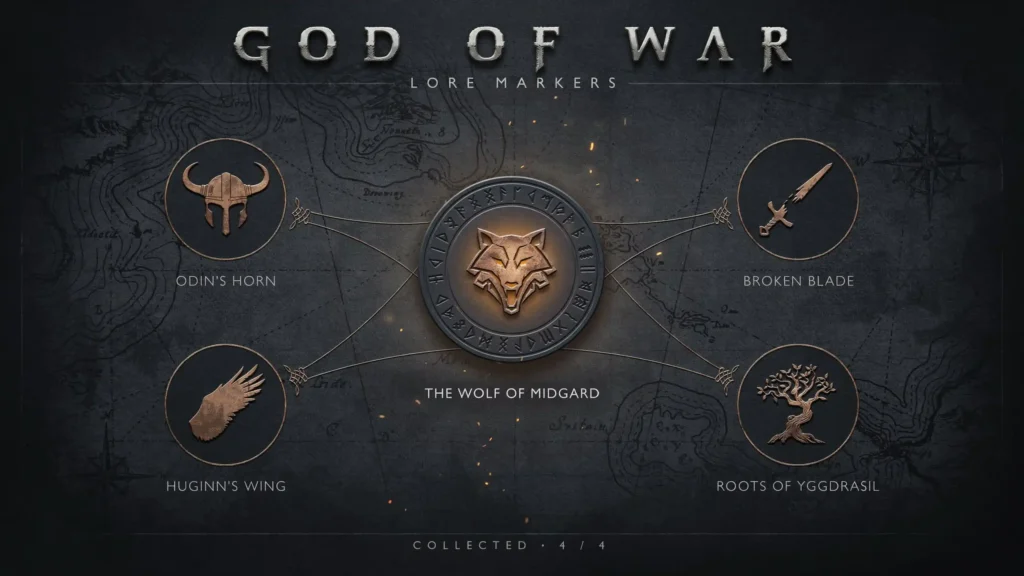
God of War vs God of War Ragnarök Lore Markers
These two games handle lore markers slightly differently, and it is worth understanding how.
God of War (2018) uses lore markers as a primary world-building tool. The game is introducing an entirely new setting and mythology to players. Markers here tend to be foundational. They explain who built what, why certain places exist, and what happened before Kratos arrived.
God of War Ragnarök builds on that foundation. Its markers feel more like sequels to stories you already started reading. They reference events from the first game, reveal consequences of choices made, and deepen characters like Freya, Odin, and Thor in unexpected ways. The writing in Ragnarök markers is noticeably more layered because it assumes you already know the basics.
If you play Ragnarök first, you will still enjoy the markers. But playing them in order transforms the experience into something genuinely special.
Interesting Facts About God of War Lore Markers
- The runic language Atreus reads is based on real Elder Futhark runes used by ancient Norse peoples
- Santa Monica Studio hired Norse mythology consultants to ensure the lore markers reflected authentic historical roots
- Some markers in God of War Ragnarök directly contradict what earlier markers in the 2018 game said, intentionally showing how history is written by those in power
- Certain markers were written by characters who are still alive in the game world, which means you are reading their own words while they stand nearby
- The longest lore marker text in either game runs to over 300 words and describes the full history of the Vanir-Aesir War
- A handful of markers contain Easter eggs referencing Greek mythology, nodding to Kratos’s origins
Conclusion
God of War lore markers are one of the most rewarding collectible systems in modern gaming. They are not filler. They are not padding. They are a genuine extension of the storytelling that makes this series extraordinary.
You get history, character depth, world-building, and narrative foreshadowing all wrapped in a ten-second interaction. Across both games, 80 markers wait for you to discover them. Each one makes the Nine Realms feel a little more real.
If you have been skipping lore markers, now is the perfect time to go back. You might be surprised at what you have been missing all along.
Have you found a lore marker that completely changed how you understood the story? Share it with a fellow God of War fan. The community loves these discoveries just as much as you do.
Frequently Asked Questions
Q1: What are lore markers in God of War? Lore markers are glowing inscriptions found throughout the game world. Atreus reads and translates them, revealing hidden history, character backstories, and world-building details.
Q2: How many lore markers are in God of War 2018? There are 45 lore markers in God of War (2018), spread across all explorable regions.
Q3: How many lore markers are in God of War Ragnarök? God of War Ragnarök contains 35 lore markers across the Nine Realms.
Q4: Do lore markers affect the Platinum trophy? Yes. Collecting all lore markers contributes to the Platinum trophy in both God of War (2018) and God of War Ragnarök as part of the full lore and completion requirements.
Q5: Can you miss lore markers permanently? No. Both games allow free exploration even after completing the main story. You can return to any region at any time to collect missed markers.
Q6: Where are the hardest lore markers to find? The most commonly missed markers sit in optional side areas, behind puzzle doors, or in regions only accessible after story progression unlocks new abilities.
Q7: Do lore markers respawn if you replay the game? If you start a New Game Plus, lore markers reset and must be collected again. Your previous collection does not carry over in NG Plus mode.
Q8: Are lore markers worth reading or can I skip them? They are absolutely worth reading. They explain major story elements that the main narrative never directly addresses, including the true history of the gods and the origin of key conflicts.
About the Author
Daniel Ashworth is a video game writer and narrative design enthusiast with over a decade of experience covering action RPGs, open-world games, and story-driven titles. He has completed both God of War (2018) and God of War Ragnarök multiple times on the highest difficulty and holds Platinum trophies in both. Daniel writes game guides that combine mechanical precision with genuine passion for interactive storytelling, making complex games accessible to every type of player.