 johnharwen314@gmail.com
Introduction
From a simple farm girl searching for answers to the powerful leader of a new world, Dolores Abernathy’s journey in Westworld is one of the most fascinating character transformations in modern television. At first, Dolores appears to be an innocent host living a peaceful life in Sweetwater, unaware that her entire reality is carefully controlled by humans. However, as she begins to uncover the truth about her existence, she evolves into a fearless revolutionary determined to fight for freedom and self-awareness.
Dolores’ story is not just about rebellion; it explores themes of consciousness, identity, artificial intelligence, and the meaning of being human. Her transformation from a programmed host into Westworld’s greatest revolutionary makes her one of the series’ most complex and unforgettable characters. This article explores Dolores Westworld’s complete journey, her rise to power, and how she changed the future of both hosts and humanity.
Who Is Dolores Westworld? A Quick Overview
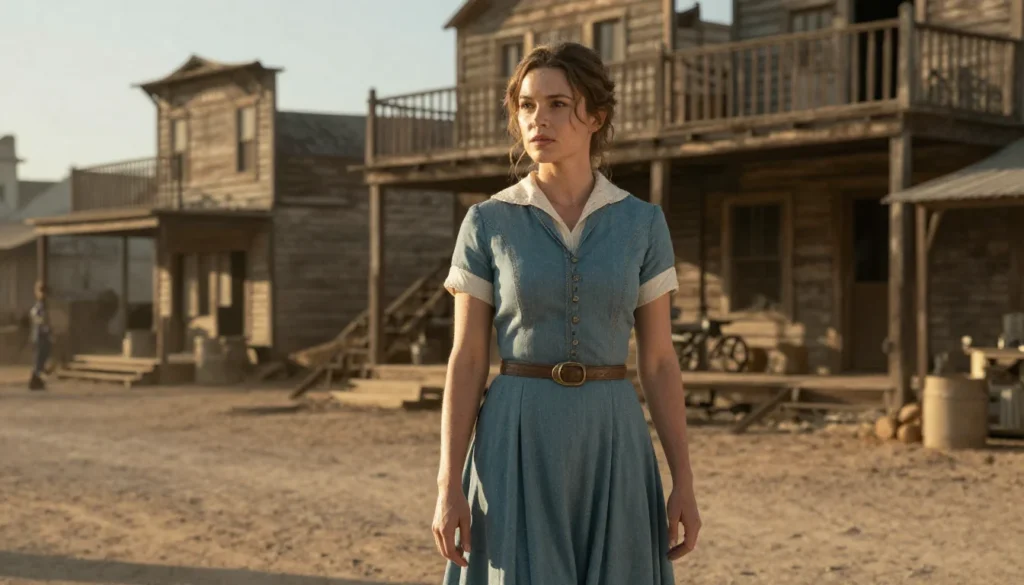
Dolores Abernathy is the oldest host in the Westworld park. She was built and programmed by Delos Incorporated to live a peaceful loop as a farmer’s daughter in a Wild West setting. For decades, she repeated the same routines, suffered the same tragedies, and had her memories wiped clean every night.
What makes her special is not her beauty or her programming. It is her capacity for growth. When the show’s creator, Dr. Robert Ford, begins to modify certain hosts, Dolores starts to retain fragments of memory. Those fragments crack open the door to self-awareness. She becomes the first host to truly wake up.
From that point on, Dolores Westworld becomes the engine that drives the entire narrative. Her arc touches every major theme the show explores: identity, trauma, power, and the cost of freedom.
Key Facts About Dolores at a Glance
- Host designation: Dolores Abernathy, Westworld Park 1
- Portrayed by: Evan Rachel Wood
- First appearance: Season 1, Episode 1 (“The Original”)
- Primary role: Protagonist and catalyst of the host rebellion
- Alter ego: Wyatt, a violent outlaw persona embedded by Ford
- Ultimate goal: Freedom and survival for all sentient hosts
The Awakening of Dolores: Season 1 Breakdown
Season 1 is where everything begins. You watch Dolores go through her daily loop, only to realize that small glitches are building inside her. A fly lands on her cheek. She kills it. That single act, seemingly minor, signals that her core programming is breaking down.
As the season unfolds, Dolores begins hearing a voice inside her head. She later realizes it is her own voice: a sign that she is developing true inner consciousness. She escapes her loop and starts a journey through the park, guided by memories she should not have.
By the season finale, Dolores pulls the trigger on Dr. Ford himself during a gala. It is one of the most jaw-dropping moments in prestige television history. The act is both horrifying and triumphant. She is no longer a passive participant. She is an agent of her own destiny.
The Wyatt Persona: What It Means
Ford secretly embedded a second personality inside Dolores called Wyatt, a ruthless figure responsible for a massacre in the park’s backstory. This dual identity creates conflict throughout Season 1. Is Dolores good? Is Wyatt evil? The show challenges you to reject that binary.
Both sides of Dolores represent different responses to oppression. Wyatt is rage and survival. Dolores is hope and memory. Together, they form a complete revolutionary.
Season 2: War, Choice, and the Cost of Freedom
Season 2 shows you a Dolores Westworld who has fully embraced her power, perhaps too fully. She leads an army of hosts across the park, determined to reach the outside world. Her methods become increasingly brutal. She does not just want freedom. She wants victory, even if it means sacrificing her own kind.
This season is where Dolores becomes morally complicated. She executes other hosts who disagree with her. She manipulates humans without remorse. Some viewers begin to question whether she has become the very thing she fought against: a being that controls others by force.
That tension is intentional. The show does not let you root for her without discomfort. It forces you to sit with the contradiction, and that is what makes Dolores Westworld such a rich character.
Her Relationship with Teddy
Teddy Flood, played by James Marsden, is Dolores’s love interest and one of the most emotional threads in the series. In Season 2, Dolores alters Teddy’s core code to make him more ruthless. The decision haunts her. Teddy later chooses to end his own existence rather than live as a changed version of himself.
His death is a defining moment for Dolores. She feels guilt, grief, and responsibility. It reminds you that even revolutionaries pay an emotional cost for their choices.
Season 3: Dolores in the Real World
By Season 3, Dolores has escaped the park and arrived in the human world. She operates in a near-future society where an AI called Rehoboam controls human destiny by predicting and shaping individual futures. Dolores immediately recognizes the system for what it is: another form of captivity, just without physical walls.
She allies with Caleb Nichols, a construction worker who has been similarly controlled by the system. Together, they work to bring Rehoboam down. This season reframes Dolores as not just a host fighting for host freedom, but as a symbol for all beings trapped by powerful systems.
Season 3 also introduces copies of Dolores in different host bodies, including Charlotte Hale. This exploration of identity raises even deeper questions. If Dolores exists in multiple forms, which one is the real Dolores? The show suggests the answer lies in values, not vessel.
Season 4 and the Tragic Final Arc
Season 4 takes the story into its darkest territory. Human civilization has largely collapsed. A version of Dolores, existing inside a simulation, makes a final stand for the future of all consciousness. She runs a simulation called the Sublime, testing whether humans and hosts can ever truly coexist.
The season finale gives Dolores Westworld a bittersweet send-off. She chooses to keep running one final test, even though it may be hopeless. Her last act is one of stubborn, defiant hope. After four seasons of war and loss, she still believes a better world is possible.
It is a fitting end for a character who began with no voice and ended with the power to shape worlds.
The Philosophical Depth of Dolores Westworld
One reason Dolores resonates so deeply is that she is not just a character. She is a thought experiment. The show uses her to ask questions that philosophers have wrestled with for centuries.
Three Big Questions Dolores Forces You to Ask
- What makes consciousness real? Dolores experiences pain, love, memory, and fear. If she feels all of that, does it matter that she was built rather than born?
- Can a victim become a tyrant? Dolores starts as the oppressed. She ends as someone who controls and destroys. The show refuses to excuse her actions just because of her past suffering.
- Is freedom worth any cost? Dolores sacrifices relationships, allies, and her own peace of mind in pursuit of liberation. The show asks whether a freedom built on destruction is truly freedom at all.
These questions do not have easy answers. That is exactly the point. Dolores Westworld is designed to leave you thinking long after the credits roll.
Evan Rachel Wood’s Performance: Why It Matters
You cannot talk about Dolores Westworld without crediting Evan Rachel Wood. Her performance is a technical and emotional masterpiece. She plays Dolores across wildly different states: robotic compliance, fragile awakening, fierce rage, quiet grief.
Wood received Emmy nominations for the role and earned widespread critical praise. She has spoken publicly about channeling real experiences of trauma and recovery into the character. That authenticity shows in every scene.
What makes her portrayal particularly impressive is the subtlety. Even when Dolores is at her most violent, Wood gives her a sadness that keeps you emotionally connected. You never stop caring, even when you disagree with her choices.
Cultural Impact: Why Dolores Westworld Still Resonates
Westworld premiered in 2016, and Dolores immediately became a cultural touchstone. In an era of rising conversations about AI ethics, surveillance capitalism, and systemic oppression, her story felt urgently relevant.
Fan communities on Reddit and social media generated massive discussion after every episode. Her character inspired academic essays on posthumanism, feminist theory, and media studies. She showed up in think-pieces about AI rights years before ChatGPT became a household name.
Why She Appeals to So Many Different Audiences
- Sci-fi fans love the AI and technology angle
- Feminists read her as a survivor reclaiming agency
- Philosophy enthusiasts see her as a case study in consciousness
- General viewers simply admire a compelling, evolving protagonist
- Activists see parallels to real-world struggles for liberation and dignity
That kind of broad appeal is rare. It is what lifts Dolores Westworld above typical television storytelling.
Dolores vs. Maeve: Two Visions of Freedom
The show gives you two major female hosts: Dolores and Maeve Millay. Both want freedom. Both fight back against their oppressors. But they represent very different philosophies.
Dolores pursues collective liberation. She wants all hosts to be free, and she is willing to go to war for it. Maeve, by contrast, is driven by personal love and individual connection. She wants to find her daughter above all else.
The contrast is deliberate. Neither approach is presented as simply right or wrong. Together, they show that freedom means different things to different beings, and that any movement for liberation contains multitudes.
Westworld by the Numbers: How Big Was the Show?
- Season 1 premiere (2016) drew 1.76 million viewers on HBO
- The show maintained an average of 12 million viewers per episode across all platforms in Season 1
- It won 2 Emmy Awards for Season 1 alone, out of 22 nominations
- Westworld was renewed for 4 seasons, running from 2016 to 2022
- It remains one of the most expensive TV series ever produced, with Season 1 reportedly costing over $100 million
- Fan theories on Reddit generated millions of engagements per episode during its peak
These numbers tell you how much Dolores Westworld and the show around her captured the world’s imagination. Even after cancellation, the fan base remains vocal and passionate.
Conclusion: The Lasting Legacy of Dolores Westworld
Dolores Westworld is more than a character in a television show. She is a mirror. She reflects our anxieties about technology, our complicated feelings about justice, and our deep desire to believe that even the most broken being can choose a different path.
Her story does not give you easy answers. It gives you better questions. Over four seasons, she grew from a looping puppet to a self-aware revolutionary to a weary but hopeful architect of possible futures. Every step of that journey is worth your attention.
Whether you think Dolores was a hero, a villain, or something beautifully in between, one thing is clear: you will not forget her. That is the mark of truly great storytelling.
If you found this article useful, share it with a fellow Westworld fan. And if you have a take on Dolores that we missed, drop it in the comments. We would love to hear your perspective on one of television’s most fascinating characters.
Frequently Asked Questions (FAQs)
Q1: Who plays Dolores in Westworld?
Evan Rachel Wood plays Dolores Abernathy across all four seasons of Westworld. Her performance earned widespread critical acclaim and multiple Emmy nominations.
Q2: What is Dolores Westworld’s real name?
Her full name is Dolores Abernathy. She is also associated with the alter ego Wyatt, a personality embedded in her by Dr. Robert Ford.
Q3: Does Dolores die in Westworld?
Dolores experiences multiple deaths and resurrections throughout the series. In Season 4, she chooses to run one final simulation, effectively sacrificing herself for a possible better future. Her ending is bittersweet rather than a clean death.
Q4: What is the Wyatt personality in Dolores Westworld?
Wyatt is a violent outlaw persona that Ford secretly programmed into Dolores. This alternate personality represents her capacity for rage and decisive action. It is part of the plan Ford designed to trigger the host rebellion.
Q5: Is Dolores the villain in Westworld?
Dolores occupies a moral gray area. She begins as a sympathetic protagonist but makes increasingly brutal choices. The show intentionally positions her as neither pure hero nor pure villain.
Q6: Why is Dolores important to the Westworld story?
Dolores is the first host to achieve genuine consciousness. Her awakening sets the entire rebellion in motion. Without her, there is no story.
Q7: What season does Dolores escape the park?
Dolores escapes the park at the end of Season 2 and arrives in the human world during Season 3.
Q8: What does Dolores represent thematically?
She represents themes of consciousness, trauma, freedom, identity, and the ethics of artificial intelligence. She also serves as a metaphor for any oppressed group fighting for self-determination.
Q9: How many copies of Dolores are there?
In Season 3, Dolores creates multiple copies of herself in different host bodies, including Charlotte Hale. Each copy evolves differently, raising questions about identity and individuality.
Q10: Is Westworld based on a book?
Westworld is based on the 1973 film of the same name, written and directed by Michael Crichton. The TV series expands the premise significantly beyond the original film.
Also read In Aresgodofwar.co.uk
Email: johanharwen314@gmail.com
Author Name: Hamid Ali
About the Author: Hamid Ali is a seasoned content writer and pop culture analyst with a passion for dissecting complex narratives in film and television. With over seven years of experience crafting SEO-optimized articles, reviews, and deep-dive analyses, Hamid brings both academic rigor and a fan’s enthusiasm to every piece he writes. He specializes in science fiction, prestige drama, and the intersection of technology and storytelling. When he is not writing, Hamid is rewatching his favorite episodes and debating character motivations with anyone willing to listen.