
In Greek mythology, ichor is the divine fluid associated with the immortal gods. Instead of ordinary human blood, the gods are described as having ichor flowing through their bodies. The clearest example appears in Homer’s Iliad, when Diomedes wounds Aphrodite and the substance flowing from her injury is identified as ichor rather than human blood.
The idea is important because Greek gods are often portrayed as remarkably human. They can feel pain, become angry, fall in love and even suffer injuries. Yet they remain fundamentally different from mortal beings. Ichor represents that difference.
Although modern fantasy often portrays it as golden blood, the earliest Greek sources do not clearly establish a specific color. The golden image developed through later interpretations and popular culture.
So what exactly is ichor, why is it connected with immortality, and what do stories about Aphrodite, Ares and Talos tell us about it?
What Is Ichor in Greek Mythology?
Ichor is the divine fluid that flows through the bodies of immortal gods instead of ordinary human blood.
The concept appears most famously in Homer’s Iliad, especially Book V. When Aphrodite is wounded by Diomedes, Homer explains that the substance flowing from her wound is the fluid found in the veins of the blessed gods.
This gives ichor a meaning that goes beyond simply being another type of blood. It marks the physical difference between mortal beings and immortal beings.
Humans have bodies subject to aging, injury and death. The Olympian gods, by contrast, possess a supernatural nature that places them beyond ordinary mortality. Ichor becomes a physical symbol of that difference.
It also helps explain an interesting feature of Greek mythology: gods can be injured without necessarily becoming mortal.
What Does Ichor Mean and Where Does the Word Come From?
The ancient Greek word for ichor is ἰχώρ. Its exact etymology remains uncertain.
The supplied classical research identifies Robert Beekes as one of the scholars who considered the word potentially Pre-Greek, meaning that it may have originated in an older Aegean linguistic layer rather than from a clearly identifiable Greek root.
Earlier attempts to connect the word with Indo-European terms associated with moisture or water have not achieved broad acceptance.
What is clearer is how the word functions in ancient literature. By the time it appears in Homer, it already seems to function as a specialized term for the divine substance associated with immortal beings.
That makes the word especially interesting from both a mythological and linguistic perspective.
Ichor in Ancient Greek Sources and the Iliad
The most important ancient evidence comes from Homer’s Iliad, Book V.
The two best-known episodes involve:
- Aphrodite, who is wounded by Diomedes.
- Ares, who is later wounded by Diomedes with Athena’s assistance.
The Iliad also describes other gods suffering injuries, including Hades and Hera, but the text does not explicitly identify the fluid from those injuries as ichor in the same way.
Later Greek authors expanded the mythology surrounding divine substances. The Talos story in Apollonius Rhodius’s Argonautica provides another important example in which ichor functions as a life-sustaining fluid.
These stories show that the concept developed beyond a single Homeric scene while retaining its association with extraordinary, nonhuman life.
How Ichor Appears in the Story of Aphrodite
The story of Aphrodite and Diomedes provides the clearest explanation of what ichor represents.
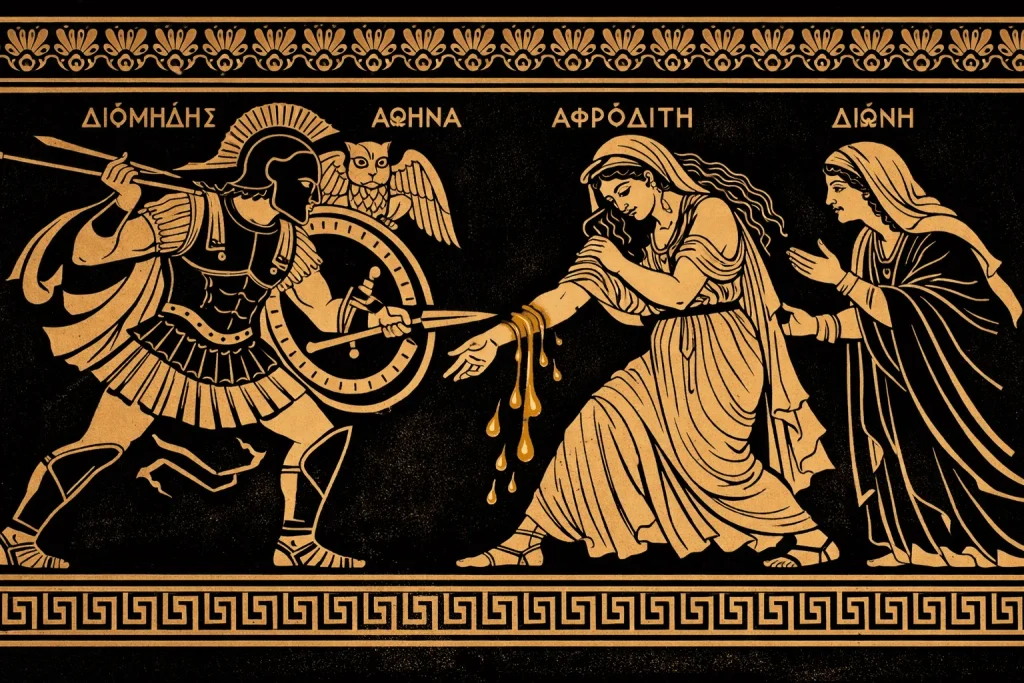
During the Trojan War, Aphrodite attempts to protect her son Aeneas. Diomedes attacks her and wounds her in the hand.
Instead of ordinary blood, ichor flows from the wound.
This detail matters because Aphrodite reacts in a very human way. She experiences pain, fear and distress. She retreats from the battlefield and seeks comfort.
Yet the ichor flowing from her wound reminds the audience that she is not a mortal woman.
The episode creates a fascinating contrast:
Aphrodite can suffer like a human, but she does not belong to the mortal world.
That is one of the most important functions of the divine blood motif in Greek mythology. It allows the gods to be emotionally and physically understandable while preserving their supernatural status.
sourecs:mythoi.org
Ares and Ichor: How Gods Could Be Wounded
Ares provides a second major example.
Later in Iliad Book V, Diomedes attacks Ares with Athena’s assistance and wounds the god of war. Ares suffers the injury and eventually retreats to Olympus.
The episode reinforces the same principle established by Aphrodite’s injury. Greek gods are not necessarily invulnerable simply because they are immortal.
They can experience pain, defeat and humiliation without losing their divine nature.
This distinction is important when interpreting Greek mythology. Immortality does not always mean that a god cannot be harmed. Rather, it means that ordinary mortal limitations do not apply to the deity in the same way.
Ichor therefore becomes a useful narrative signal. When divine blood appears, the injury itself does not transform a god into a mortal.
Talos and His Single Vein of Ichor
The story of Talos takes the idea of ichor in a very different direction.
Talos was a gigantic bronze guardian associated with Crete. Ancient traditions differ about his exact origin. Some versions connect him with the Bronze Race, while others associate him with Hephaestus and Minos.
What makes Talos especially important is his unusual body.
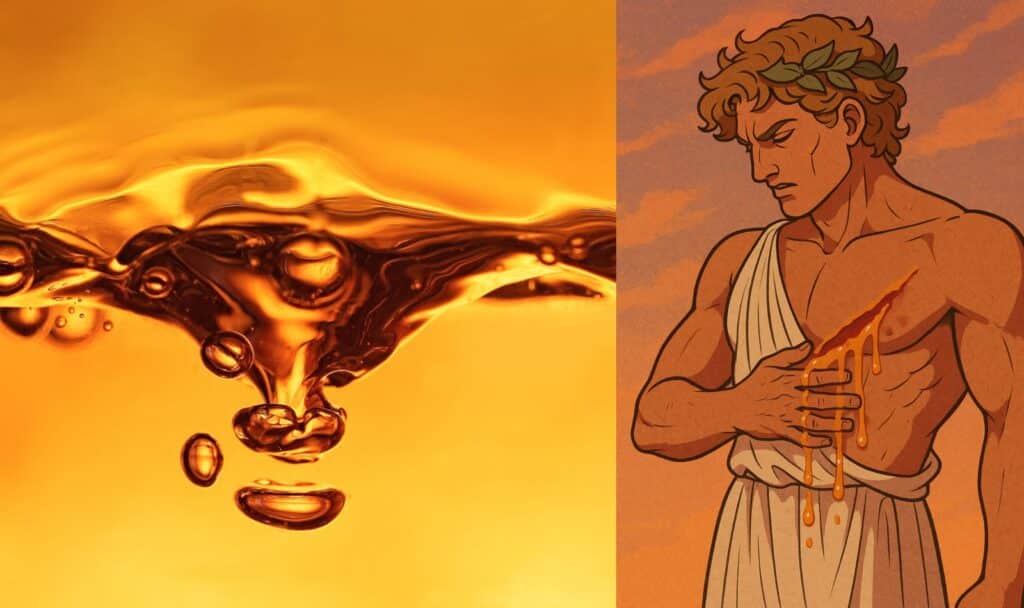
He is described as having a single vein running from his neck to his ankle, sealed at the lower end by a bronze nail or plug. Ichor flows through this vein and functions as the vital substance keeping him alive.
When the Argonauts approach Crete, Talos prevents them from landing by throwing rocks at their ship.
Medea eventually defeats him through magic and deception. In the Argonautica tradition, Talos injures the vulnerable point around his ankle, allowing the ichor to escape. The liquid flows out and Talos collapses.
This story makes Talos particularly fascinating because he is not simply an Olympian god. His body combines bronze construction, mechanical imagery and divine life fluid.
It also demonstrates that the mythology of ichor could be adapted to describe an extraordinary artificial or supernatural being.
Ichor vs. Human Blood: What Is the Difference?
The simplest distinction is that human blood represents mortal life, while ichor represents divine or extraordinary life.
| Feature | Human Blood | Ichor |
|---|---|---|
| Associated with | Mortal beings | Immortal or supernatural beings |
| Symbolism | Mortality and human life | Immortality and divine nature |
| Famous mythological example | Mortal heroes and humans | Aphrodite and Ares |
| Role in injury | Can accompany mortal death | Marks divine injury without ordinary mortality |
| Famous ancient source | Broadly present in Greek literature | Homer’s Iliad |
The distinction is symbolic as much as physical.
Greek mythology frequently gives its gods human emotions and recognizable bodies. Ichor provides a reminder that these beings ultimately belong to a different order of existence.
Ichor, Ambrosia and Nectar: How Are They Connected?
Ichor is often discussed alongside ambrosia and nectar, but the three concepts should not be treated as identical.
In Greek mythology, ambrosia is associated with the food of the gods, while nectar is associated with their drink. Ichor, by contrast, is the divine fluid within their bodies.
This creates a useful conceptual relationship:
Ambrosia and nectar → divine nourishment → ichor as divine circulation
The exact mythology is more complicated than a simple biological formula, but the three concepts collectively reinforce the distinction between gods and mortals.
Humans depend on ordinary food and drink and eventually die. The gods belong to a supernatural order sustained by divine substances and protected from ordinary mortality.
Is Ichor Really Golden?
Not necessarily. The earliest famous descriptions do not clearly say that ichor is golden.
The popular image of golden ichor is widespread today, but Homer’s description of Aphrodite’s injury focuses on the substance being divine rather than specifying its color.
The association with gold likely became stronger through later artistic and literary traditions.
Gold already carried strong associations with divinity in Greek culture. Gods could have golden objects, clothing, ornaments and other attributes. Over time, imagining divine blood as golden or luminous became an intuitive way to visually distinguish it from human blood.
Modern fantasy, novels, films and video games have strengthened this image even further.
Therefore, it is more accurate to say:
Golden ichor is a popular interpretation, not a firmly established color in the earliest Homeric account.
What Does Ichor Symbolize in Greek Mythology?
Ichor has several layers of symbolism.
1. The boundary between mortal and immortal
Ichor physically separates gods from humans. It represents a different kind of existence.
2. Divine immortality
The substance helps ancient audiences understand why gods can survive injuries that would threaten mortal life.
3. Vulnerability without mortality
Aphrodite and Ares can be wounded and experience pain, yet their injuries do not make them ordinary mortals.
4. Divine nature
The fluid becomes a material expression of what makes a supernatural being different.
This is perhaps the most interesting feature of the concept. Greek gods are neither completely human nor completely incomprehensible. They occupy a space between recognizable human behavior and supernatural existence.
Ichor helps maintain that boundary.
Which Greek Gods Had Ichor?
Greek mythology generally associates ichor with the immortal gods, but the clearest explicit examples in Homer are Aphrodite and Ares.
This distinction matters.
It is tempting to assume that every Greek god is explicitly described in every ancient source as having ichor flowing through their veins. The surviving evidence is more limited.
Aphrodite’s injury provides the strongest Homeric description, while Ares provides another major example.
Other gods are wounded in mythology, but the ancient texts do not always specifically mention ichor in connection with those injuries.
Talos represents a separate case because his extraordinary body contains ichor even though he is not an Olympian deity.
Does Ichor Make the Greek Gods Immortal?
Ichor is strongly associated with immortality, but it is better understood as a sign and expression of divine immortality rather than a simple magical substance that automatically creates immortality.
In the mythological framework, the gods are fundamentally different from mortals. Their divine nature, nourishment and supernatural existence all contribute to their immortality.
Ichor makes that difference visible.
The Talos story adds an interesting complication. Talos depends on the ichor flowing through his single vein, and losing it results in his death. This makes the fluid appear much more directly connected to life in his particular story.
So the safest interpretation is that ichor is a defining divine life substance, while its exact relationship to immortality varies according to the myth.
Ichor in Modern Literature, Fantasy and Pop Culture
The word survived long after ancient Greek religion.
In later English usage, ichor acquired a medical meaning associated with unpleasant wound discharge. The older mythological association remained influential, however, and the word eventually became popular again in fantasy and speculative fiction.
Modern audiences may encounter ichor in:
- Fantasy novels
- Mythology-inspired fiction
- Video games
- Comic books
- Role-playing games
- Modern retellings of Greek mythology
The term is especially useful for writers because it immediately suggests something that resembles blood but is not ordinary human blood.
Works and franchises inspired by Greek mythology, including Percy Jackson, God of War, and Hades, have helped keep mythological concepts such as divine blood, Olympian gods and supernatural bodies familiar to modern audiences.
However, modern fictional uses do not necessarily represent what ancient Greeks believed. Contemporary fantasy often adds properties such as glowing colors, corrosive effects or special powers that are not established in the earliest sources.
Common Misconceptions About Ichor
Misconception 1: Ichor was always golden
The earliest Homeric description does not establish gold as its color. The golden image is largely a later interpretation.
Misconception 2: Ichor and ambrosia are the same thing
They are not. Ambrosia is associated with divine food, while ichor is the fluid associated with divine bodies.
Misconception 3: Every god is explicitly described as having ichor
The concept is associated with immortal gods, but explicit ancient descriptions are more limited. Aphrodite and Ares provide the clearest Homeric examples.
Misconception 4: Ichor automatically kills humans
Ancient sources do not establish a universal rule that touching ichor automatically kills every mortal.
Misconception 5: Ichor is simply another word for blood
In Greek mythology, its importance comes precisely from the distinction between divine fluid and ordinary mortal blood.
Frequently Asked Questions About Ichor
What Is Ichor in Greek Mythology?
Ichor is the divine fluid associated with immortal gods and supernatural beings. In Homer’s Iliad, it flows from Aphrodite’s wound instead of ordinary human blood.
What Is the Difference Between Ichor and Human Blood?
Human blood is associated with mortal life, while ichor represents the supernatural nature and immortality of divine beings.
Which Ancient Texts Mention Ichor?
The most famous reference is Homer’s Iliad, especially Book V. Ichor also appears in the Talos story in Apollonius Rhodius’s Argonautica and related later traditions.
Which Greek Gods Had Ichor?
Aphrodite and Ares are the clearest Homeric examples. The broader tradition associates the substance with immortal gods, while Talos provides a notable supernatural example.
Why Is Ichor Associated With Immortality?
Ichor represents the fundamental difference between divine and mortal bodies. It appears when gods are wounded but remain immortal, making it a symbol of divine existence beyond ordinary mortality.
Do Demigods Have Ichor or Human Blood?
Greek mythology does not establish one universal biological rule for every demigod. Most demigods are portrayed as mortal or partly mortal rather than as fully immortal Olympian gods, so it is safer not to assume that every demigod possesses ichor.
Final Takeaway
Ichor is more than the “golden blood” of Greek mythology. At its core, it is a mythological way of showing the difference between gods and mortals.
Homer’s descriptions of Aphrodite and Ares demonstrate that gods can suffer physical pain without becoming mortal. The story of Talos expands the concept by placing ichor inside a remarkable bronze guardian whose life depends on a single sealed vein.
The golden color commonly associated with ichor is memorable, but it should not be confused with the earliest evidence. Ancient Greek sources focus much more strongly on what the substance represents: divine life, supernatural nature and existence beyond ordinary mortality.
That is why ichor remains one of the most memorable concepts in Greek mythology. It gives an otherwise abstract idea—immortality—a physical form.
Also Read: